Dead Formats, Living Fandoms: Why We Keep Going Back to Entertainment That Was Supposed to Be Gone
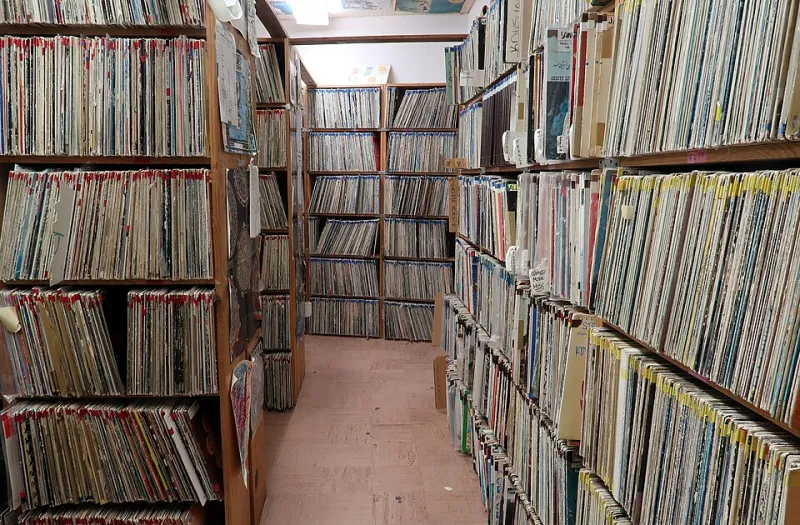
Photo: Melikamp, CC BY-SA 4.0, via Wikimedia Commons
A few years ago, the entertainment industry had a clean story to tell about progress. Streaming killed cable. Digital killed physical media. The algorithm would surface what you needed before you even knew you wanted it. The future was frictionless, personalized, and infinite.
Somebody forgot to tell the consumers.
Vinyl record sales have now outpaced CD sales for multiple consecutive years. Criterion Collection Blu-rays sell out. Board game cafes are packed on Friday nights. Podcast networks are building entire shows around deep-dives into TV series that ended before some of their listeners were born. "Gilmore Girls." "The Wire." "Buffy." "Deadwood." Shows with devoted fanbases that refuse to treat the ending as an ending.
And then there's the revival industrial complex — "And Just Like That," "Frasier," "That '90s Show," "Dexter: New Blood," "The X-Files" comeback, "Twin Peaks: The Return." The reboots keep coming because the demand keeps coming.
This is worth taking seriously as a cultural signal, not just a monetization trend.
The Algorithm Problem Nobody's Officially Admitting
If you've spent any real time on a major streaming platform lately, you've probably experienced a version of the same frustration: a library of thousands of titles, and somehow you end up watching the same five things, or spending 25 minutes browsing and giving up entirely.
This isn't a bug. It's an intentional design feature. Recommendation algorithms optimize for engagement and retention, which in practice means they surface content that's most likely to keep you on the platform — not content that's most likely to challenge, surprise, or genuinely expand your taste. Familiar genres. Safe choices. Content that resembles what you already watched.
The irony is that the infinite content model, which promised total personalization, has produced a kind of aesthetic sameness. Peak TV gave us a hundred dramas that look, sound, and feel remarkably similar. Streaming pop music has converged around production styles that test well on playlists. The algorithm, in trying to give you more of what you want, has subtly narrowed what you're offered.
For a growing number of people, the deliberate friction of older formats — hunting for a specific record, rewatching a DVD you own, re-reading a physical book — feels like resistance to that narrowing. It's a way of choosing your own inputs rather than accepting what the machine curates.
The Economics Underneath the Aesthetics
There's a less romantic explanation too, and it deserves space: economic anxiety.
Physical media doesn't disappear from a library when a streaming deal expires. A record you buy stays yours. In an era where beloved shows vanish from platforms without warning — "The OA," "I Am Not Okay With This," dozens of others — owning something physical is a hedge against algorithmic impermanence.
Millennials, who came of age during the 2008 financial crisis and are now navigating student debt, housing costs, and inflation, have a particular relationship with the idea of ownership versus access. The streaming model is fundamentally a rental model — you pay monthly for access that can be revoked. Physical media is ownership. For a generation that's been told repeatedly that they can't afford the traditional markers of stability, owning your entertainment library is one of the few domains where the economics still make sense.
Gen Z, meanwhile, grew up in a world where nothing digital feels permanent. Social platforms disappear. Apps sunset. Content gets deleted. There's a practical wisdom in the vinyl collector or the physical game library — these things persist in ways that a streaming playlist simply doesn't.
Revival Culture and the Sequel Nobody Asked For
The TV revival wave is its own beast, and it operates on different logic than physical media collecting.
When a streaming platform greenlights a "Frasier" reboot or a "Saved by the Bell" continuation, they're not doing it out of artistic conviction. They're licensing an existing fanbase. A show with 20-year-old fans is a show that arrives pre-marketed. The nostalgia does the awareness work that a new IP would need a massive advertising budget to achieve.
But here's the thing — audiences know this. And they show up anyway. Sometimes they show up critically, ready to be disappointed, treating the revival as an event to react to rather than a show to genuinely invest in. The discourse around revivals has become its own entertainment genre. The anticipation, the hot takes, the comparison threads — that's all content, and it's content that the original show, in its original run, never generated at this scale.
So the revival isn't really just about the show. It's about the community that forms around the show — and in many cases, the revival is the excuse for that community to reconvene. "Gilmore Girls: A Year in the Life" was fine. The 18 months of fan discussion that surrounded it were electric.
Appreciation, Anxiety, or Something Else?
The honest answer to whether this retro consumption wave is genuine artistic appreciation or economic anxiety or algorithmic pushback is: probably all three, depending on who you're asking.
For some people, buying a Criterion Blu-ray of a Cassavetes film is genuinely about the experience of watching a movie with intention, with context, with supplemental essays and commentary. That's real cinephile culture, and it's been around forever — it's just more visible now because it has an online community.
For others, the vinyl collection or the physical book shelf is aesthetic identity-building — a way of signaling taste in a world where digital consumption leaves no visible trace. Your Spotify history is private. Your record shelf is a statement.
And for plenty of people, it's simpler than either of those things: they just miss something specific. A show that felt like it ended too soon. A format that made music feel like an event rather than background noise. A slower pace of consumption that didn't feel like keeping up with a feed.
The Disposable Entertainment Problem
What ties all of this together is a growing discomfort with the disposability baked into current entertainment culture. When everything is available all the time, nothing feels special. When a streaming platform drops 10 episodes of a show at once and expects you to consume it in a weekend, the experience is closer to processing than it is to watching.
The retro consumption wave is, in part, a rejection of that pace. Watching a show week-to-week — even by choice, even by buying the DVD and rationing it — changes the relationship. It creates anticipation. It creates space for reflection between episodes. It makes the thing feel like it matters.
That's not a small thing. In a media landscape designed to make you move on as quickly as possible, choosing to slow down is a genuine act of resistance — even if you're doing it while wearing a vintage band tee you bought on Depop.
The formats we keep resurrecting aren't dead. They're just inconvenient. And apparently, inconvenience is exactly what some of us are looking for.